When my first dog, Jacques, was a puppy, he drew admirers everywhere he went. He was a Jack Russell Terrier who had a shiny, all-white coat save for his brown ears and a perfectly placed brown spot on one eye— he basically looked like the dog emoji 🐶, which I always thought was the Internet gods’ idea of what the perfect dog looks like. I got so used to strangers gushing at his cuteness and wanting to be his friend that I thought that all puppies received the same treatment. All puppies are cute, after all. Or so I thought.
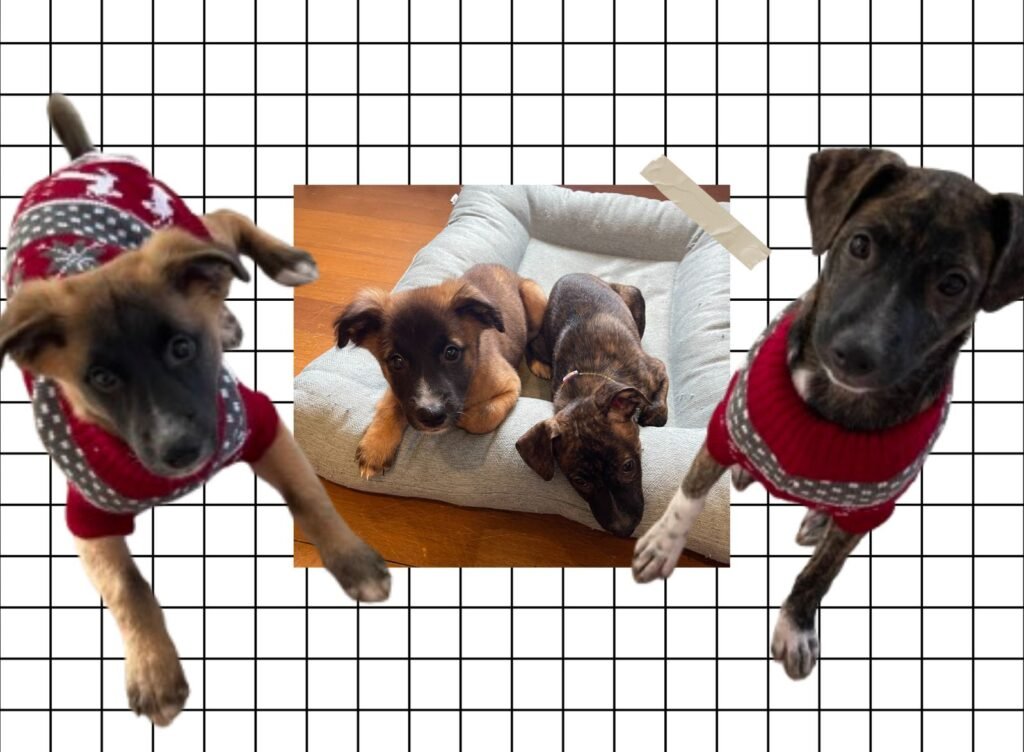
My rude awakening came when my husband and I recently adopted two Aspin puppies, Frankie and Scottie. We brought them to the mall for the first time a few weeks ago and when we got home after our excursion, I remember feeling disgruntled. Something was not sitting right with me and I did not know why. When I thought about it, I realized that it was because the whole time we were at the mall, not a single soul took notice of the puppies. No compliments, no admiring glances. People just passed by them like they didn’t exist. I felt so offended for my girls.
I looked back on our afternoon at the mall to pinpoint what went wrong. I remembered the girls being adorable in their brightly-colored harnesses. I remembered them walking through the park in unison, like twins— what a picture! I remembered them perfectly behaving like ladies, even though they were barely 3 months old. What went wrong?
When I compared that afternoon with my experience with my Jack Russell Terrier, I came to this realization: that perhaps Scottie and Frankie were ignored at the mall because they are Aspins and, for Filipinos, Aspins are not as cute and desirable as dogs of foreign breed. Compared to my “picture-perfect” Jack Russell Terrier, Frankie and Scottie look like the usual dogs one sees on our streets. Frankie is dark and spindly, what Filipinos call a witch dog or “asong gubat,” and Scottie has nondescript brown fur, the kind common to Aspins, and a face so dark I have to look hard to see her eyes. Who would take a second, admiring glance at them?
It was with much reluctance that I landed on the above realization because for the past few years, I had been happily basking in the thought that Filipinos are now finally welcoming Aspins into their homes as beloved companion animals and as part of their families. On social media I saw stories of billionaires and celebrities in their homes where their rescue Aspins were treated like royalty and I thought, the world is finally healing. If these influential people are now embracing Aspins as companion animals, I thought, for sure everyone else would soon follow suit. Sometimes, when I would see Aspins living on the streets in heartbreaking conditions, I would tell them, “Worry not— you, too, will soon be living the life of the rich and famous!” Or at least in the loving arms of a family living in a cozy townhouse.
I clung onto that beautiful thought perhaps because I sincerely believed that the world is now becoming kinder to Aspins, or perhaps because it conveniently appeased my conscience for how I’m unable to do anything beyond giving them a bit of food when I come across them on the streets. Regardless, my bubble burst when my two Aspin puppies came into my life. I started paying close attention to how the world perceived and received Scottie and Frankie and realized that the reality of Aspins living in comfortable, loving homes is still a special case, an ideal that is far from being the norm. When it comes to fully embracing Aspins as companion animals, we Filipinos still have a long way to go.
The challenge is that while on social media we often talk about adopting and not shopping, and praise people who rescue animals off the streets, when appreciating Aspins, we somehow still instinctively do so in comparison to dogs of breed. The more similarities the Aspin has to a breed, the more desirable the dog becomes in our eyes.
Some weeks ago, my husband and I attended a holiday gathering. We brought our new puppies along so they may meet everyone. Everyone was nice to the puppies, as expected, but I noticed that when complimenting Scottie and Frankie, well-meaning people would say things like, “Wow, they’re so beautiful— they look like they’re breeds!” and “This one looks like a German Shepherd!” It’s as if Aspins can be beautiful only insofar as they look like they have “pedigree.”
It follows, of course, that this also affects the “adoptability” of an Aspin. The kind lady who rescued Scottie and Frankie’s litter off the streets shared with us her fear that she will be unable to find homes for all the puppies in the litter. Apparently, the puppies who look like they are of breed— that is, those with soft, long fur and whose colors are not the usual Aspin brown— are easier to rehome than those who look like ordinary street dogs. In finding adopters for the puppies, she also had to navigate around people who were glad to welcome Aspins into their homes, but only in their yard or garage to serve as “bantay.” These were the same people who would keep dogs of breed inside their homes, dogs who were worthy of being loved like family, but would also keep Aspins in cages or chains by their gate. Not all puppies are cute— some are not cute enough to have a loving home.
As these realities became more obvious to me, I looked back on how I, myself, viewed Aspins as companion animals before Frankie and Scottie came into my life. I tried to remember the thoughts that would cross my mind when I would, say, come across a stranger with his Aspin pet at the mall. What I remember thinking is not that the dog is beautiful but that I admire the person for having an Aspin pet even if the dog is just an Aspin. I would focus on the person’s kindness because I saw having an Aspin pet as an act of kindness, and the Aspin as a charity case. It’s like saying that only a person with a heart of gold will adopt an Aspin because Aspins are not beautiful on their own and have nothing to offer except brownie points in heaven. I realized that I am part of the problem. I, a proud vegan who claims to value every being’s life, viewed Aspins as less than other dogs. In my own way, I was discriminating against Aspins. I just wasn’t aware of it.
The problem is that for all our efforts to create a kinder, more loving world for Aspins, it seems that discriminating against them is like instinct for us Filipinos, always at work even when we don’t even notice it. One possible explanation for this comes to mind. Perhaps, like with our attitude towards everything in this world— our standards for female beauty, music, film, literature, fashion, food, etc.— our relationship with Aspins is also shaped by our deeply-rooted colonial mentality. Foreign dog breeds are beautiful while our very own local dogs are not.
I began to look at my own actions and intentions. I feared that I was unwittingly applying this same mindset to Scottie and Frankie. I suddenly became very aware of my obsession to get them the prettiest collars, leashes, and clothes. Our previous dog never owned clothes and used the same harness all his life even when it was already smelly and in tatters. Why am I suddenly obsessed with canine fashion? I realized that I was doing this not purely for the fun of it nor for my puppies’ comfort but also because I was desperate to set them apart from the usual Aspins. I wanted them to look different from— to look better than— the usual dogs I see on the streets, so that when people see them they will not think that they are “just Aspins.” But what is so wrong about being just an Aspin anyway?
I thought about how I can rid myself of this mindset. With my other lifestyle and cultural preferences shaped by colonial mentality, I have found that it helps to take a step back and reflect— do I like this something because I truly find it beautiful, or do I like it only because I have been trained by my colonized past to like it? If I judge this Filipino movie, for example, according to its own merits and not in comparison to the foreign movies I have grown up with and loved, what will I honestly think of it? It is when I allow myself this moment of reflection and consciously separate myself from my reflex to judge according to my westernized standards that I am able to properly form a point of view that is free from the noise of colonial influence. I decided to try using this technique on Aspins.
And so I took a step back and looked at Scottie and Frankie and judged them for who they are, as Aspins, and not according to the standards of foreign dog breeds. I looked at Frankie, my spindly witch dog, and I saw an elegant and graceful puppy that always looks pensive, like she’s always thinking of something very important. I looked at Scottie’s dark face and I saw someone so full of mischief but also so full of charm you can’t get mad at her. I looked at them for who they truly are, as Aspins and as individuals, and I saw that they are beautiful and I love them. And when I look at the Aspins on the streets I now see Scottie and Frankie in them, my beautiful Aspins with the most special personalities, and I find them beautiful and I love them, too.