Makati is a place that trains us to hurry.
When I was living there, many years ago, I remember moving through the city with my eyes always fixed on the next meeting, the next errand, the next light turning green. In many ways, the city trained me to be hyper-focused and hyper-vigilant. To waste no time. Adapt or leave, the city seemed to say. Assimilate or be left out. I learned to edit out what was deemed inconsequential or that which did not belong in the polished ecosystem of urban life.
For years, that was the case for me. And then, one day, one cat changed my whole field of vision. That cat was Zenny—the cat who expanded my heart and set me on the path toward animal welfare advocacy.
Long before Cats of Legaspi Village (COLV) became what it is now, there was simply a growing awareness that cats’ lives have value. That they were trying, as all animals do, to survive in the world we had made.
I was there in those early days as a resident of Legaspi Village, and I created the group’s Facebook page. In time, I would end up adopting Zenny—the cat who had brought COLV’s founding members together in the first place because he was scamming all of us into feeding him. It is difficult for me to tell this story without tenderness, because in many ways this story changed my own life too.
It also brought me to Carmine Collera, COLV’s lead caregiver, and the person who first opened my eyes to TNVR.
I have since moved out of Makati, and began my own initiative, Kapon Ampon. But over the years, I have repeatedly found myself grateful for everything I learned from Carmine and COLV.
Recently, I caught up with Carmine to understand how Cats of Legaspi Village is doing today—what has changed in the past 8 years, how the system now works, and what lessons she might offer to all of us who are trying to care for community cats in our own neighborhoods.
Creating a Kinder Community
Cats have always been part of the landscape of Legaspi Village. Long before COLV was formed, the neighborhood cats had their allies: guards who welcomed their company, residents and employees who fed them occasionally, jollijeep tinderas who gave them scraps. But they also lived with uncertainty. Some establishments tolerated their presence; others called MACEA to have them rounded up and removed.
When Cats of Legaspi Village entered the picture in 2018, for the first time, the cats had something like organized backing—a group of people willing to advocate for them, a visible voice on social media, and a system of care that aimed to assuage their suffering. TNVR—trap, neuter, vaccinate, return—became the cornerstone of that effort, helping keep the cats healthier while addressing cat overpopulation at the root.
Over time, the work began to reshape how the neighborhood saw the cats.
COLV’s Impact in Numbers
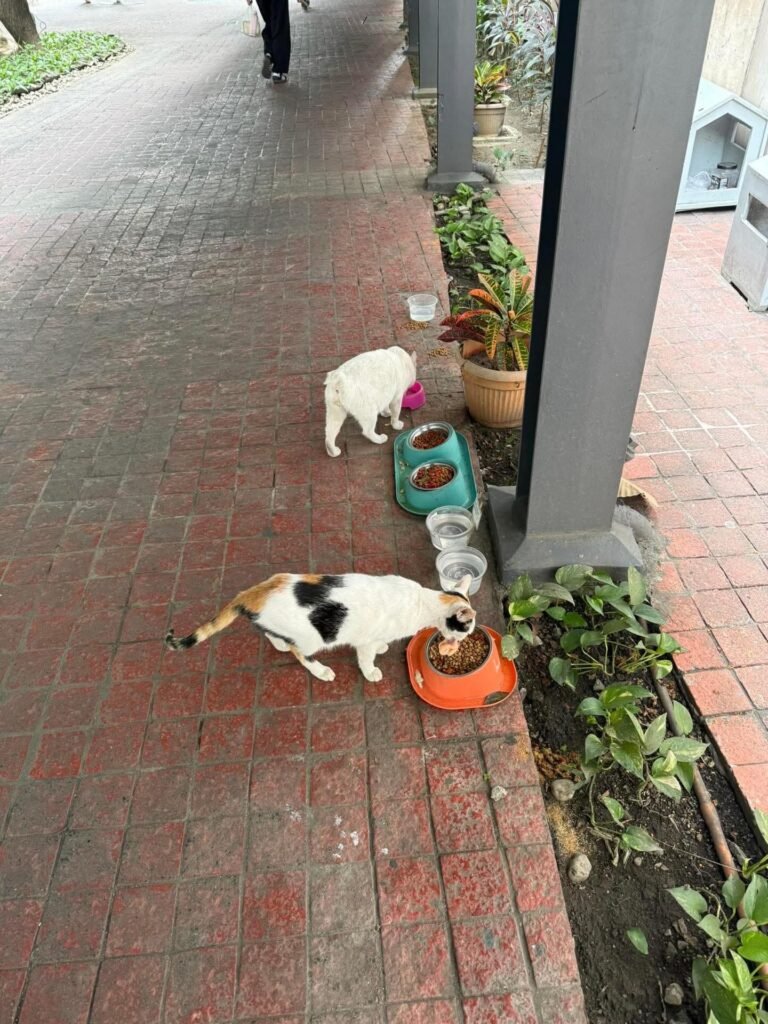
Today, Cats of Legaspi Village cares for a surprisingly large network of animals.
Roughly 80 to 90 cats are currently under shelter or foster care, while the broader street population across the area is estimated at around 300 cats.
The group supports feeding sites across 24 buildings, with cat food donated to several building caretakers.
Yet the human team behind this work remains small. Fewer than twenty volunteers are actively involved in the community.
The scale of the effort becomes even more striking when you consider the daily commitment required to sustain it.
Between caring for cats at home and managing the group’s online page, Carmine spends no less than five hours a day on COLV.
The Power of a Cat Community
For Carmine, the success of COLV cannot be measured by TNVR or rescue numbers alone. “A community is what makes this work sustainable and successful,” she says.
She recalls a moment that captures this clearly. One afternoon in February, a foreign resident noticed an abandoned, dying cat outside a café. The group’s usual clinics were fully booked, but an appointment opened the next day. The man borrowed a carrier. A security guard—someone COLV had worked with before—agreed to keep the cat overnight. The following day, the cat was brought to the vet. After treatment, the cat was released to a feeding site where volunteers had placed a simple box shelter. The cat took it as his own. Last week, the cat was sent to the clinic for TNVR.
Moments like these underscore the importance of the infrastructure behind the work. “When you have a cat community,” Carmine says, “you have a network of people you can tap.” Low-cost veterinary partners. Sponsors who trust the work enough to support it financially. Volunteers willing to catch a cat, hold a carrier overnight, bathe a dirty cat, or check on a mother and kittens. “Cat lives are transformed by people,” she adds, “and a thriving community makes that possible.”
The results are not always dramatic, but they are visible: stability in colonies, a shift in how residents see the cats, and—most tellingly—the animals themselves. “Look at the cats,” Carmine says. “Observe how they behave in the community.” Cats that move with ease, rather than fear, are often the clearest sign that coexistence has begun to take root.
What becomes clear, then, is that sustaining a cat community is, at its core, about managing a human one.
Managing Humans
Cats may be central to the work of COLV, but the human ecosystem surrounding them requires just as much navigation. Carmine coordinates regularly with guards, residents, building administrators, and businesses. “I talk to anyone who would listen about cats and what can be done in the community,” she says.
Conflicts inevitably arise, particularly around feeding practices or the presence of cats in shared spaces. Over time, Carmine has found that a simple but formal approach is often most effective. “A formal letter is more apt for the culture,” she notes.
Equally important are the boundaries required to sustain the work. Good intentions, she has learned, do not always translate into alignment. “People can be helping cats and mean well,” she says, “but you do not necessarily have to work with them.”
After eight years, Carmine has come to see that sustainability is ultimately a function of people. “Get the right people on board,” she says, emphasizing that a small, reliable team is far more effective than a larger group that is not aligned with the work. Beyond the core team, a broader support network—residents, guards, clinic partners, and sponsors—becomes essential.
Experience has also shown her that even well-meaning actions can have unintended consequences. Removing newborn kittens without a plan, repeatedly reporting cases without offering help, animal abandonment and dumping, or feeding in ways that create mess and complaints can all undermine the long-term stability of a community cat program.
In the end, managing cats is only part of the work; managing people is what makes it possible.
TNVR as a System
In a neighborhood as dense as Legaspi Village, TNVR has to function like a system—predictable and coordinated. The first Saturday of every month is dedicated to catching cats for kapon; Wednesdays are release days, when the animals are returned to the territories they know.
After eight years of consistent TNVR, the nature of the challenge has also changed. Prioritizing which cats to sterilize is no longer the central question; most of the neighborhood cats are already kapon. Now the challenge is in getting the most elusive ones, the cats that slip between buildings and avoid traps, the ones who go to basements that the COLV team has no access to.
One misconception on TNVR that Carmine often encounters is the belief that female cats should be prioritized for kapon. In reality, she explains, gender matters far less than opportunity: every intact cat contributes to reproduction, with the exception of urgent cases such as pregnant cats that must be brought to the vet immediately.
Clinic partnerships are essential to sustaining this system. The group regularly works with veterinary partners such as Biyaya Animal Care, CARA Welfare Philippines, and Makati Animal Health Clinic.
Keeping the Community Cats Healthy
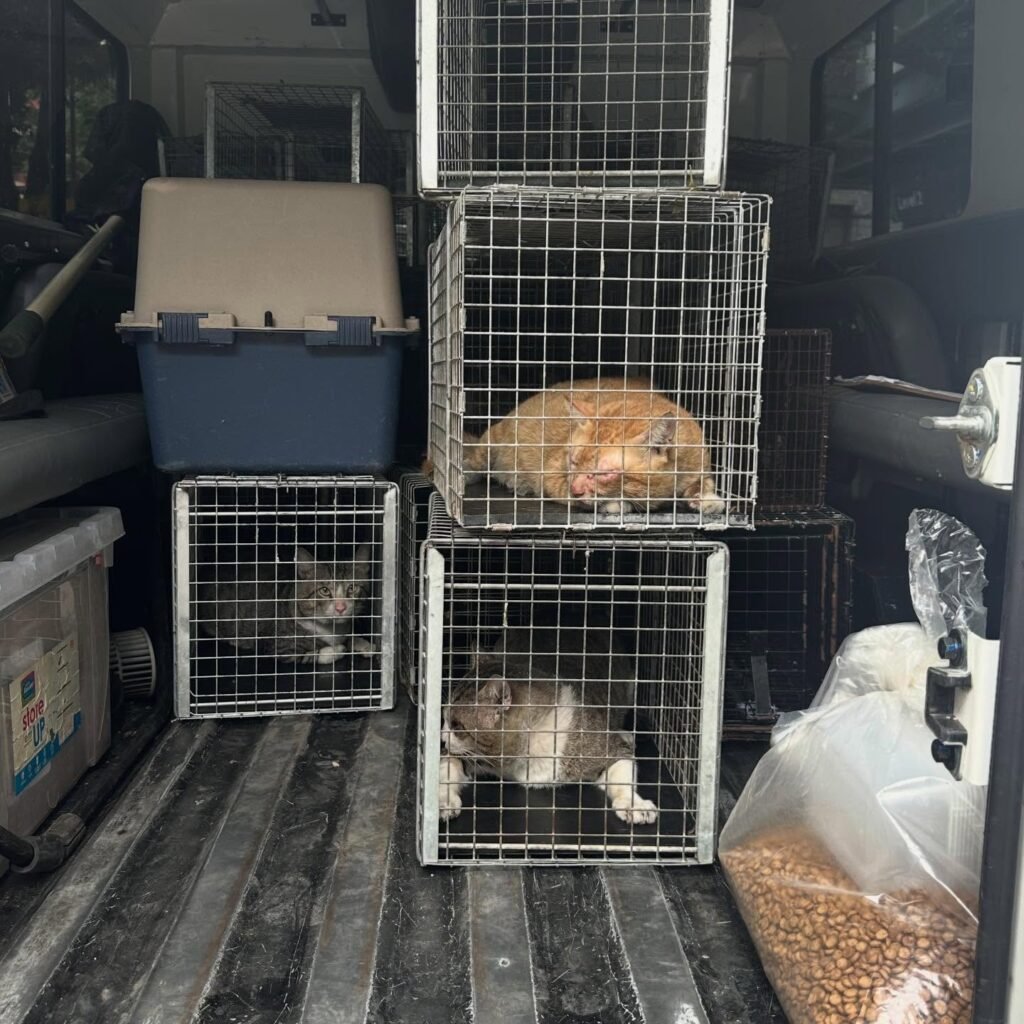
Keeping a population of community cats healthy requires constant vigilance and a system that can respond quickly when a cat becomes ill or injured. In Legaspi Village, the most common health issue Carmine sees among the cats is respiratory illness.
When medical emergencies arise, the group relies on a network built over years of trust. Carriers are kept on hand and can be lent to people who report an injured or sick cat and are willing to help transport the animal to a clinic. In recent years, pet transport services willing to handle cats in carriers have helped lighten the logistical burden.
But Carmine observes there is one resource that remains consistently underestimated: the caregiver’s personal time. “Even with transport services and established relationships, the time spent coordinating is as valuable as the cost of vet expenses, or of the rescue itself,” Carmine says.

On Adoptions: Finding the Right Home for the Right Cat
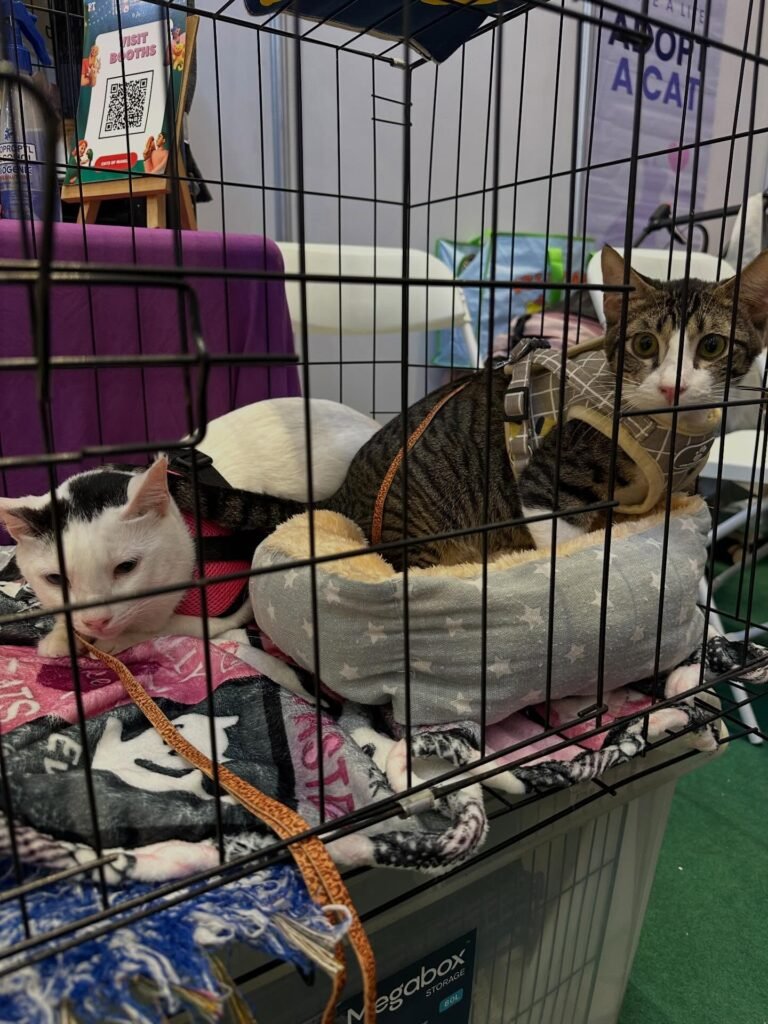
Cats of Legaspi Village approaches adoption as an initiative that strengthens the TNVR program. But Carmine believes not every cat is meant to leave the streets, and part of the group’s responsibility is knowing the difference. The cats prioritized for adoption are the friendly ones who lack the instincts needed to survive outdoors, young kittens, as well as TNVR cats who have grown too vulnerable to remain in the community and need a safe place to retire. The feral cats and those that are thriving in their territories are left where they belong. According to Carmine, “These cats are part of the community and have an important role to play for the TNVR program to work.”
In screening adopters, the process is thorough. Prospective adopters answer a questionnaire, agree to an adoption contract, provide identification and photos of their home, and may undergo a home visit before the match is finalized. Carmine also keeps a few clear non-negotiables to protect the cats’ long-term welfare. “All animals in the home must be spayed or neutered,” she says. “The household must not resemble a shelter-style setup, and adopters must commit to feeding species-appropriate food.”
Cat Community Best Practices
For anyone beginning their own neighborhood effort, Carmine’s advice is straightforward: focus first on TNVR. Even sterilizing one to three cats a month can begin to change the trajectory of a colony. Over time, progress reveals itself in these signs: a steady cadence of TNVR runs, injured or ill cats receiving care, sponsors who continue supporting the work, and adopters who step forward. Many of these stories, she says, never make it to social media.
Looking back, there is one thing she wishes she knew when she was first starting out as a community cat caregiver. “Choose the path of least resistance,” Carmine says. While it is ideal to have everyone on board—especially decision-makers—bureaucracy can often slow progress. Instead, “Try to push the glass ceiling for community cats with small, intentional actions daily until they become integrated in the community,” Carmine advises. “So that the next admin who comes onboard treats the cats as a given or part of the territory, not a problem to be solved.”
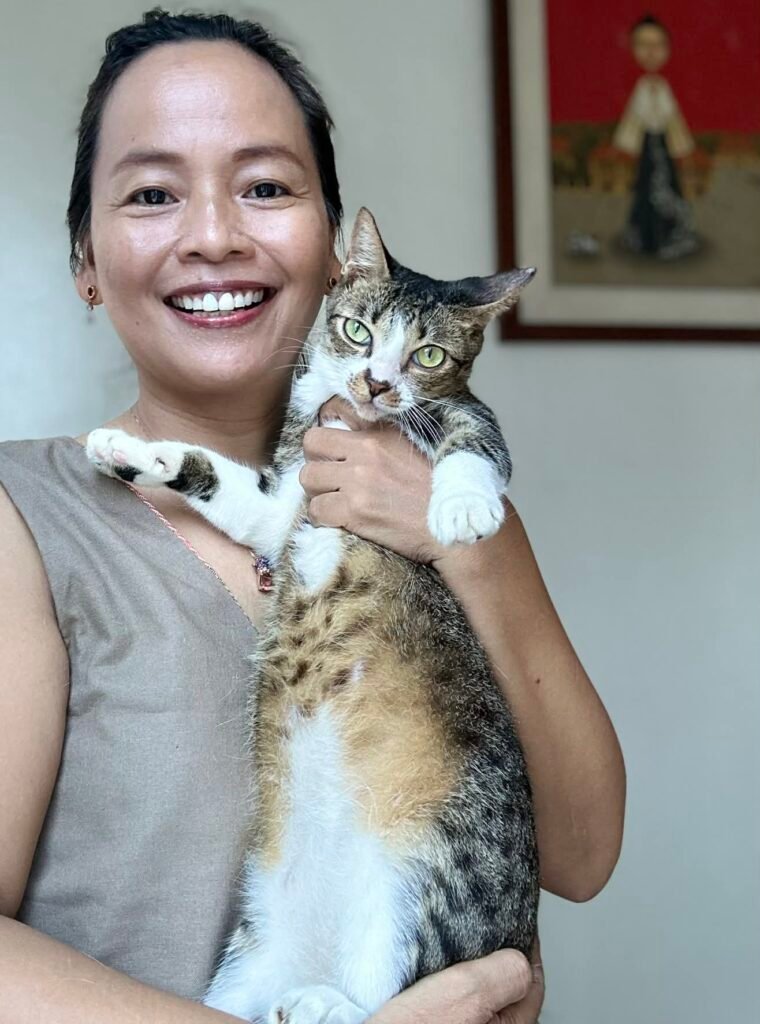
Carmine also points to a larger reality shaping the work today. “The number of cats in foster care and those abandoned daily, the number of rescuers joining the adoption market indicate that we are competing for a finite supply of qualified homes,” she says. “We must focus on integrating cats as members of the community.”
What Cats of Legaspi Village demonstrates, after eight years, is that community cat care is not only possible, but sustainable. The invitation to take part remains open. “We still need heroes,” Carmine says. “The goal is to continue finding more people who can share the work.” Those who wish to get involved may reach out to Cats of Legaspi Village on Instagram or Facebook.