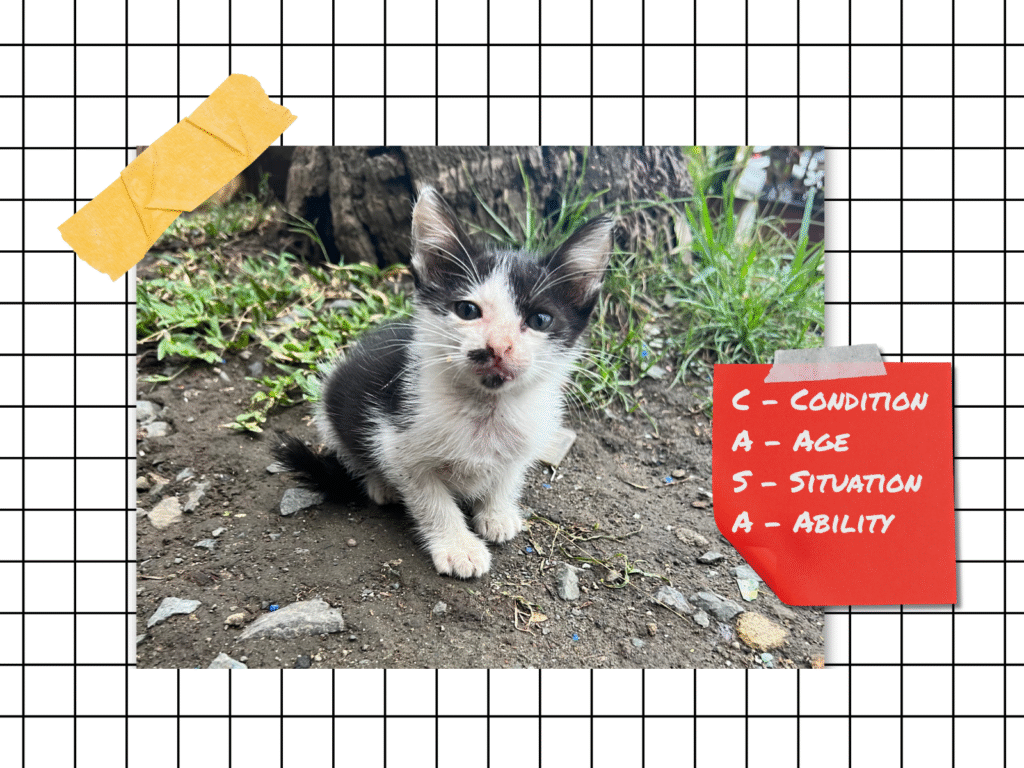
You’re on your way home, already thinking about rest, when a tiny shape stops you in your tracks—a kitten, alone and meowing. Your instinct might be to scoop them up immediately. But before you do, pause. According to Hannah Shaw—better known as the Kitten Lady—not every kitten you find is truly abandoned. To help you decide the right course of action, she offers an easy acronym to remember: CASA.
C– Condition
A – Age
S – Situation
A – Ability
Condition
The first step is to assess the kitten’s physical condition. A kitten in good condition is usually clean, alert, chunky, and well-fed, showing no signs of distress. This often means their mother is likely nearby, even if you can’t immediately see her.
A kitten in poor condition, on the other hand, will appear dirty, visibly underweight, weak, or in medical crisis. These kittens may be orphaned and often need immediate human intervention.
Age
Once you’ve assessed their condition, the next factor to consider is age. Knowing how old a kitten is will help you determine the safest and most appropriate response.
Newborn kittens (0–5 weeks) are uncoordinated, have closed or baby-blue eyes, and are completely dependent on their mothers for warmth, milk, and hygiene. At this stage, it’s crucial that they remain with their mother whenever possible.
Kittens aged 5–12 weeks are playful, coordinated, able to walk and run, and can already eat on their own. This is their prime socialization window, making it the ideal age for rescue, fostering, and adoption.
Kittens 12 weeks and older usually weigh three pounds or more, no longer nurse from their mother, and have a more proportionate or lanky body. At this age, kittens may already be feral and difficult to socialize. For them, sterilization and return to their colony is often the safest and most humane option.
Situation
Every kitten’s situation is different, so careful observation is essential. Ask yourself: Is the environment safe? Is the mother nearby? Is there a caregiver or pet owner present? Does the kitten have access to food, shelter, and protection?
An unsafe situation includes exposure to extreme heat or rain, moving vehicles, flooding, predators, or clear abandonment. During the rainy season especially, kittens need dry shelter and warmth. After observing both condition and age, you can better judge whether intervention is truly necessary.
Ability
This is where compassion meets practicality. Helping a kitten should always aim for the best outcome for the animal, while working within your real-life limits. Ask yourself:
–Are you or someone you know able to provide foster care?
–Can you access sterilization services for the family?
Not every kitten needs to be taken home. If their mother or a caregiver is nearby, the best help may be continued monitoring or support instead of removal. While the urge to adopt or foster can be immediate and emotional, it’s important to assess not only the kitten’s condition—but your own capacity as well.
There is no single solution that fits every kitten. Each situation depends on their CASA: Condition, Age, Situation, and your Ability to responsibly intervene.
And one last reminder: wherever there are kittens, there are almost always adult cats. Never take newborn kittens without checking thoroughly for their mother. Advocate within your community, work with local rescuers, and help protect both kittens and adult cats through responsible, informed action.