I’d like to begin with a simple request: read this through to the end.
I know this is not the easiest subject. An article about farmed animals rarely is, especially if you like your fried chicken, your steak, your lechon. Especially in a culture where food is often inseparable from tradition, memory, and survival. I’m not here to ask you to abandon your favorite meals or perform moral purity overnight. Nothing in this article is meant to judge or overwhelm.
But I am asking that you allow yourself to know. That you make space, even briefly, for the conversation around farmed animals in the Philippines. Please let the awareness build. Because empathy can only take root when we allow ourselves to see.
Most people do not spend much time thinking about farmed animals unless they work in agriculture, policy, or animal welfare. They exist at the far edge of public consciousness, transformed into products long before they ever enter our field of empathy. We know our companion animals intimately. Our cats and dogs. They have names, personalities, a place in our homes. But the animals raised within industrial food systems remain largely invisible, even as they feed millions of us every day.
And it’s in the unseen, in what we don’t look at, don’t question, don’t talk about, where our attention is needed.
So before your next meal, pause for a second. Look at what’s on your plate. See it not just as food, but as something that had a life before it reached you.
Let’s start somewhere easy. Let me introduce you to Animal Empathy Philippines (AEP)—a nonprofit founded in 2021 that works to improve the lives of farmed animals in the Philippines by building a community of informed, action-oriented changemakers, and advocating for more humane, sustainable food systems.
A Movement Rooted in Empathy and Evidence
For Animal Empathy Philippines, the issue begins with a reality that most societies have learned to keep at a comfortable distance: the immense scale of suffering experienced by animals raised for food.
Kate Lupango, Co-Founder and Executive Director of Animal Empathy Philippines, points out that while billions of chickens, pigs, fish, and other farmed animals move through food systems every year, their welfare remains largely absent from public conversation. In the Philippines, many of these animals are raised within intensive production systems designed primarily for efficiency and output. Chickens can spend their entire lives in overcrowded facilities. Pigs are often confined in restrictive enclosures that leave them vulnerable to chronic stress, injury, and disease.
“The way we treat animals reflects the kind of society we want to build,” Lupango says. “Violence and suffering should never be normalized, especially when there are opportunities to create more sustainable and compassionate systems.”
But AEP is careful not to frame the issue as a simplistic moral binary between “good” and “bad.” The organization sees farmed animal welfare as part of something much larger: a systemic issue deeply connected to public health, food security, labor, sustainability, and the kind of society we are collectively building.
What makes AEP’s approach distinct is that it focuses on helping people confront realities they may have never been encouraged to think about before. They believe lasting change happens through shifts in public consciousness—through empathy informed by evidence. The organization focuses on education, advocacy, research, and community-building. Because once something becomes visible, it becomes harder to dismiss. And once people begin asking questions about systems they once accepted without thought, the possibility for change, however gradual, begins.
Changing the Conversation Around Farmed Animals
Since its founding, Animal Empathy Philippines has helped grow a network of students, researchers, professionals, and advocates working to push farmed animal issues further into public consciousness. Some have gone on to launch their own initiatives, including PARO Institute, a local organization focused on alternative proteins, while others have pursued research or joined international organizations working in farmed animal advocacy. “When we started, our goal was to build a community of people from different backgrounds who share the same vision of creating a more compassionate future for farmed animals,” Lupango says. “For us, these are meaningful signs that more Filipinos are beginning to see farmed animal advocacy as an important area for long-term work and engagement.”
At the same time, AEP has worked to push farmed animals into conversations where they have historically been absent. Through talks, collaborations, research initiatives, and educational resources, the organization has tried to highlight the connections between food systems and wider social issues. “We believe that farmed animal issues are not isolated concerns,” Lupango says. “They are deeply interconnected with public health, disaster resilience, climate change, biodiversity, and environmental sustainability.” For AEP, progress is not measured only through policy wins or public campaigns, but through cultural shifts: more people volunteering, asking questions, exploring plant-based alternatives, supporting advocacy work, and engaging in conversations that, until recently, barely existed in the mainstream at all.
Expanding the Circle of Compassion
At the heart of AEP’s philosophy is the belief that moral progress begins when people widen the boundaries of who they include within their ethical concern. “We view empathy not simply as an emotional reaction, but as a driver of moral progress,” Lupango says. “Much of the suffering experienced by farmed animals today exists because their welfare is often excluded from public attention and moral consideration despite their capacity to feel pain, stress, and suffering.”
What AEP advocates for is not the replacement of one form of compassion with another, but an expansion of it. The organization often speaks about moral circle expansion—the philosophical idea of widening the range of beings we extend empathy toward. “This is not about asking people to choose between caring for companion animals or farmed animals,” Lupango explains. “Rather, it is about encouraging people to extend the same compassion they already show toward companion animals to other animals raised within food systems as well.”
And slowly, she believes, that shift is already underway. Some animal shelters have begun rescuing pigs alongside dogs and cats. Communities have rescued stranded cows during floods instead of abandoning them as livestock. More students are pursuing research and projects centered on farmed animal welfare. Individually, these moments may seem small. Together, they suggest something larger: a culture beginning, however gradually, to reconsider who deserves care.
“Expanding empathy does not diminish our care for people,” Lupango says. “It strengthens our ability to build systems rooted in compassion, responsibility, and long-term thinking for both animals and society.”
Lupango points to philosopher Jeremy Bentham’s enduring question as one that continues to shape conversations around animal welfare today: “The question is not, Can they reason? nor, Can they talk? but, Can they suffer?”
From Awareness to Infrastructure
One of the organization’s major priorities this year is leadership development through the upcoming launch of the Changemaker Academy, a program designed to equip future advocates with the skills, knowledge, and strategic thinking needed to advance farmed animal welfare across different industries and communities. “One of our key priorities is building more Farmed Animal Champions,” says Lupango. Alongside this, the organization plans to deepen its policy engagement, continue producing local research on food systems and animal welfare, and expand public education efforts through talks, community engagements, and informational materials. Upcoming research projects include studies on aquaculture policy in the Philippines and community-based approaches to African Swine Fever prevention—part of AEP’s broader effort to ground advocacy not only in empathy, but in evidence and systems thinking.
That systems-level perspective also shapes how the organization views the country’s evolving legislative landscape. Lupango sees recent animal welfare proposals, including measures filed by Representative Leila de Lima, as meaningful signs that animal welfare is beginning to enter more serious public and policy conversations. “Policy and legislation play a highly important role in advancing farmed animal welfare, especially in creating long-term and systemic protection for animals raised for food,” she says. “These steps make us hopeful. It signals a shift. And if built on, can set a precedent that benefits farmed animals in the long run.” Still, she notes that farmed animals remain largely underrepresented in policymaking despite the scale of suffering embedded within industrial food systems. While the Animal Welfare Act provides an important legal foundation, AEP believes there is still urgent need for clearer welfare standards, stronger implementation, and policies that directly address issues such as confinement, transport, disaster response, and disease prevention.
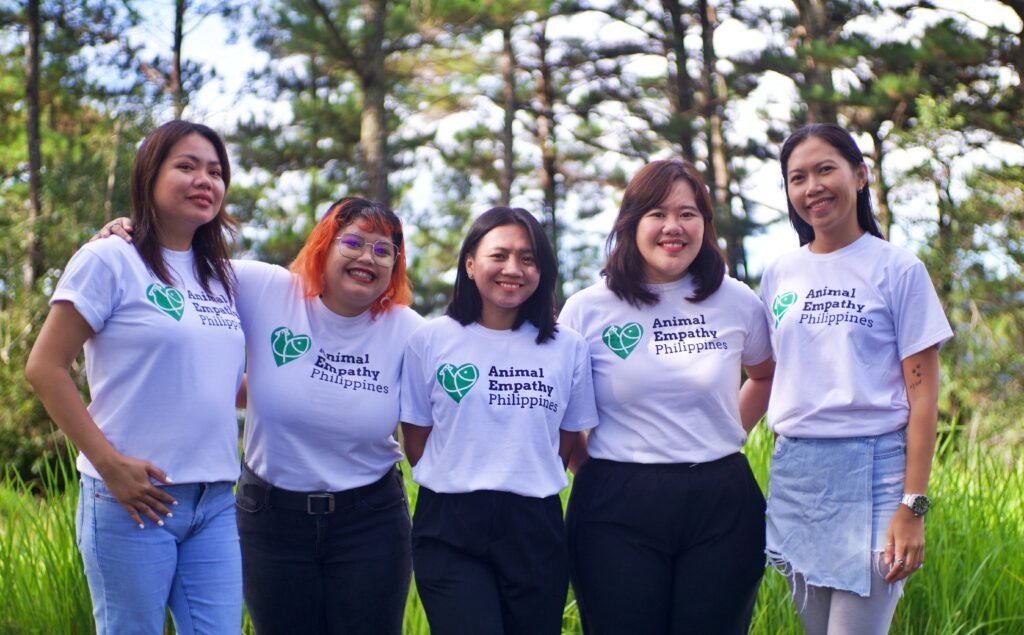
FROM LEFT TO RIGHT: GING GERONIMO, CO-FOUNDER AND DIRECTOR OF SPECIAL PROJECTS; LORA CERDAN, COMMUNICATIONS MANAGER; JANE BAHIL, PROGRAM AND ADMIN MANAGER; KATE LUPANGO, CO-FOUNDER AND EXECUTIVE DIRECTOR; AND EM QUINTANA, COMMUNICATIONS OFFICER OF ANIMAL EMPATHY PHILIPPINES
How to Become Involved
For those who want to learn more, volunteer, support the movement, or simply begin the conversation, more information can be found through Animal Empathy Philippines. Those interested in contributing their skills may sign up as a volunteer through the organization’s initiatives, join the Pinoys for Farmed Animals community in Facebook, subscribe to the AEP Newsletter, or book a direct conversation with the team through Book a Conversation with AEP. AEP also regularly shares updates and educational resources through its social channels, including Facebook, Instagram, LinkedIn, and TikTok.
Perhaps the most important thing Animal Empathy Philippines wants people to understand is that there is space for them in this movement, wherever they are starting from. You do not need to become an activist overnight. Sometimes change begins simply with curiosity, with a difficult conversation, with a willingness to look more closely at systems we have long taken for granted. “Meaningful change does not happen all at once,” Lupango says. “It begins when people become more open to learning, asking questions, and taking small but intentional steps toward creating better systems for animals.”
HELP US BUILD A KINDER WORLD FOR ANIMALS
Your support fuels stories that push for real change in animal welfare across the Philippines.
Founder & Editor-at-Large
Martha is the founder of Pawsture, and the co-founder and lead caregiver of Kapon Ampon (IG: @kapon.ampon), a grassroots effort that practices TNVR, does daily feeding of community animals, and fosters vulnerable cats. A seasoned marketing and communications strategist, she’s spent years mastering the language of brands. Now, she uses that same fluency to make people care about puspins and aspins. She believes the smallest lives deserve the loudest voices, and she’s made it her business to make sure they’re heard.