Sterilization, or kapon, whether performed through a flank or traditional approach, remains the backbone of Trap–Neuter–Vaccinate–Return (TNVR), the globally recognized framework for managing free-roaming animal populations. Neutering refers to the sterilization of males, while spaying refers to females. As such, spay surgery is an essential skill in the veterinary field.
Flank spay is one of two widely used surgical techniques for sterilizing female dogs and cats, the other being the midline approach. Particularly suited to mass kapon programs and community animal management, flank spay involves entering the abdomen from the side rather than along the midline. In high-volume settings, this approach can support shorter procedures, quicker recoveries, easier monitoring of the incision site in free-roaming animals, and a faster return to the street for those that cannot remain long in clinics.
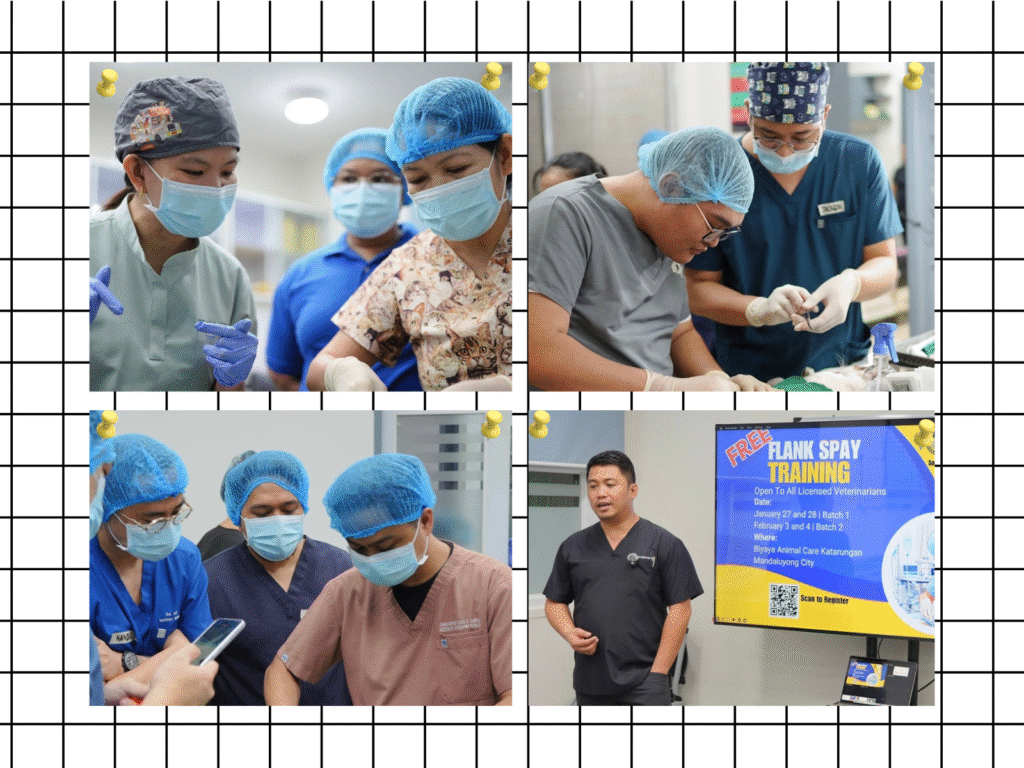
In late January and early February, Biyaya Animal Care conducted two batches of free Flank Spay Training sessions in partnership with the Mandaluyong City LGU. The trainings were held on January 27–28 and February 3–4, 2026, and were attended by veterinarians from local government units and private clinics across Metro Manila and several provinces.
In a public statement, The Biyaya Animal Care Foundation said the initiative aimed to promote shared best practices in addressing the stray animal population. “Let’s normalize sharing best practices to address the stray animal population because gatekeeping never solved a public problem,” the organization wrote. It added that sustainable solutions require training LGU and private veterinarians at no cost and treating the operating table as “a shared learning space.”
The first batch gathered veterinarians from Mandaluyong, Las Piñas, Makati, Pasig, Pasay, Marikina, and Manila. Participants also traveled from San Pedro, Laguna; Dasmariñas, Cavite; and Bulacan. The mix of attendees represented both highly urbanized areas and neighboring provinces with active community animal populations.
The second batch drew a wider geographic range. Participants came from Pasig, Taguig, Mandaluyong, Makati, Caloocan, Marikina, San Juan, Quezon City, Valenzuela, Malabon, Parañaque, Las Piñas, and Manila, including Sta. Ana and Tondo. Veterinarians also attended from Alabang; Calamba, Laguna; Apalit, Pampanga; Lucena and Mauban, Quezon; Cabanatuan and Nueva Ecija; Pangasinan; Zambales; Cavite; and Bulacan.
The participation of multiple cities and provinces underscored the demand for standardized, scalable sterilization training across regions.
Rina Ortiz, founder of Biyaya Animal Care, said the training was designed to strengthen national capacity.
“We conducted this training for LGU and private veterinarians because animal population control has already tipped past prevention—we are now playing catch-up. To have any chance of catching up, we need methods that are simpler, faster, more economical, and scalable, without compromising animal welfare.”
Ortiz added that pairing sterilization with anti-rabies vaccination strengthens both animal welfare and public health outcomes.
“Training in flank spay and efficient spay-neuter protocols allows vets to operate with shorter surgical times, less downtime for animals, quicker return to communities, and lower overall costs, while pairing this with anti-rabies vaccination addresses population control and public health at the same time.”
She emphasized that the workshops focused on capacity-building rather than isolated intervention.
“More than technique, this is capacity-building across the Philippines. No single organization, LGU, or clinic can do this alone. What makes this work is shared learning, trust, and camaraderie—vets from different sectors coming together, exchanging skills, and strengthening one another.”
The workshops reflect a collaborative approach to stray population management, prioritizing training, standardization, and inter-city cooperation as part of long-term strategy.