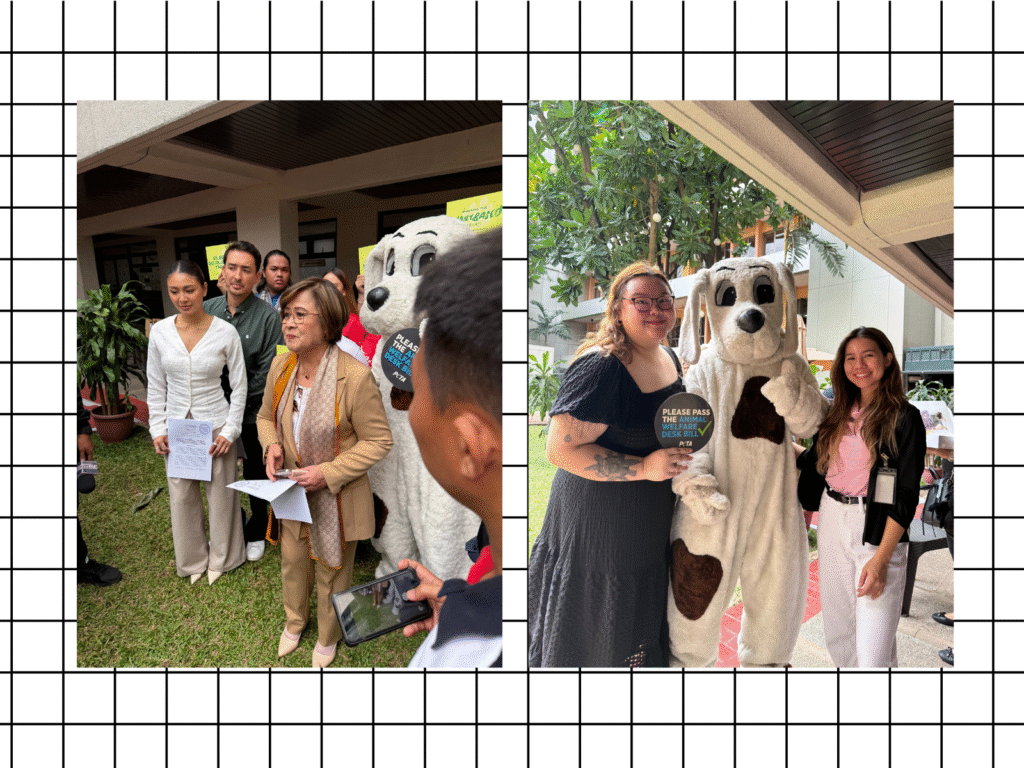
A low murmur of excitement spread across the lobby of the House of Representatives as Representative Leila De Lima prepared to file three measures: the Animal Welfare Enforcement Act, the Gulay para sa Kalusugan at Kalikasan Act, and a Resolution calling for urgent ecological inquiry. Animal welfare and environmental groups stood in unified support — a rare alignment across intersecting advocacies.
We waited eagerly for her to step into the scene. Around us, organizations clustered according to their shirts — PETA, PAWS, CARA, Biyaya Animal Care, Animal Kingdom Foundation, Pawssion Project. I was pleasantly surprised to see Plant-Based Treaty and Animal Empathy Philippines also present. Actress Nadine Lustre and her advocate partner, Christophe Bariou, were there as well. It was only then that the weight of the moment became clear: we were there to witness not just one but three filings converging animal welfare, plant-based reform, and environmental protection under a single legislative push.
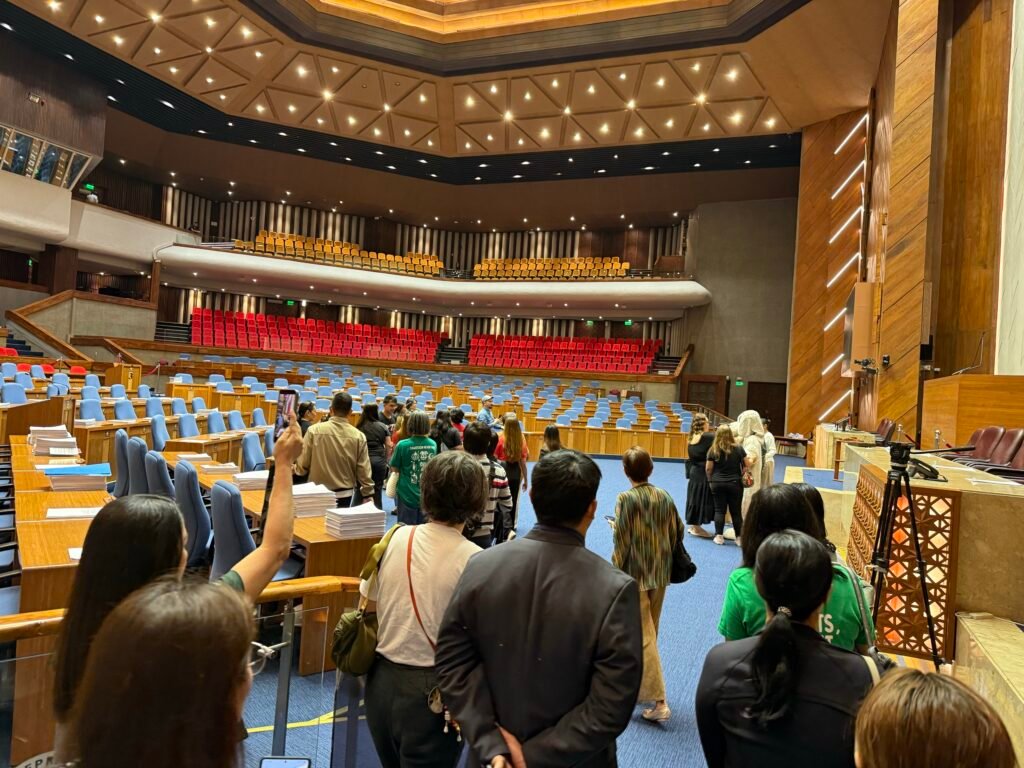
The first Bill, the Animal Welfare Enforcement Act, would establish Animal Welfare Desks in all police stations. These desks will assist citizens with any concerns of animal cruelty, from pet neglect, to illegal slaughter, to wildlife trafficking. Oftentimes advocates would take to social media and tag organizations, hoping upon a prayer something will be done. But through this Bill, Animal Welfare Officers manning the desks can be directly approached for help in reporting violations, learning about salient laws, and safely and humanely handling animals when needed.
An Ombudsman Unit will also be established to provide centralized oversight and ensure the quality of public service delivered by these desks. Through this Bill, citizens are empowered to protect animals and uphold the law, without relying solely on social media or overly burdened NGO’s. Our citizens do care; this Bill gives them an avenue to do so meaningfully. Our laws already offer apt resolutions; this Bill paves the way for its rightful enforcement.
The second Bill, the Gulay para sa Kalusugan at Kalikasan Act, will promote plant-based meals in public institutions, as well as sourcing produce locally to support our farmers.
Tangentially, the third measure was a House Resolution focused on environmental protection, encouraging congressional investigation into our current sustainability efforts in the country, eventually updating policies and scaling the movement to protect our natural resources.
These three filings are only initial steps in the full legislative process; a number of hearings and committee reviews must still be held before they can pass into law. Nonetheless, they represent a holistic step in the right direction. As an advocate, I’m moved by the promising foundations being laid on all three fronts. The necessity of pursuing advocacy in the realm of policymaking cannot be overstated: when a concern is enshrined by the law of the land, the country is bound to protect it. The animals and environment sorely need this visibility.
One striking feature of this trifold event was its intersectionality — the alignment among advocacies. Alongside the Desk Bill, the Gulay Bill is not only beneficial for our health and environment, but also a subtle ally in animal welfare. Non-plant-based food is derived from animals too — just the kind we consider consumable. But they are animals nonetheless, as capable of joy and suffering as any dog or cat. Their welfare and lives matter too. Likewise, the Resolution, which bolsters environmental protection, ultimately protects wildlife and marine life. And herein lies the intersectionality: advocacies can resonate with and reinforce one another. Advancing one often advances the others.
It is a beautiful convergence I often find in my own pursuit of animal welfare, sustainability, and veganism. I only wish more people recognized how easy it is to expand your compassion in the world, just by starting small.
I’m also intrigued by the visible camaraderie among animal welfare groups, which, behind the scenes, can sometimes find themselves divided in their approaches. The Desk Bill, however, appears to unite them. Despite varied methods of conducting their noble work, key organizations unanimously support it.

Lastly, it was refreshing to find prominent figures in show business joining in on the fight, even if it’s an arguably countercultural cause — certainly risky, considering how our culture is the very basis of their bread and butter. I felt a similar sense of pride during the 2022 general elections, when celebrities spoke up in support of Leni Robredo. Truly, fighting the good fight is not always easy, but always worth it. And in this case, the animals, environment, and local farmers thank Nadine and Christophe for utilizing their wide platform to enact good in the world. We need more like them.

At the close of the event, passionate speeches were delivered to the press, emphasizing the importance of the newly filed Bills and Resolution. Personally it felt serendipitous to witness animal welfare, veganism, and environmentalism — my three dearest advocacies — coalesce in this single powerful moment.
In the words of Alexander Hamilton in the famed theater production, “This is not a moment; it’s a movement.” I can only hope the Desk Bill, Gulay Bill and House Resolution move forward with sustained momentum, strengthened by their shared resonance.
This is proof that intersectional advocacies are the way forward. Surrounded by fellow advocates, I was reminded that it all boils down to one simple ingredient: compassion.
Legislated compassion is a powerful force for change in our country. And with enough push, this is how we get there.